

Every media channel has its own way of measuring success.
Paid Search is evaluated by conversions. Social by engagement. Video by completed views. Television by reach and frequency. Each metric serves a purpose, but because every channel speaks a different language, it can be difficult to understand how they contribute to the media plan as a whole.
Recently, we started looking at media plans through a different lens. Instead of evaluating each channel by its own success metric, we converted every tactic into Gross Rating Points (GRPs), a standard media metric that estimates how much advertising exposure a target audience receives. The goal wasn’t to replace traditional performance metrics. It was simply to create a common point of comparison across an entire full-funnel media mix.
What we found surprised us.
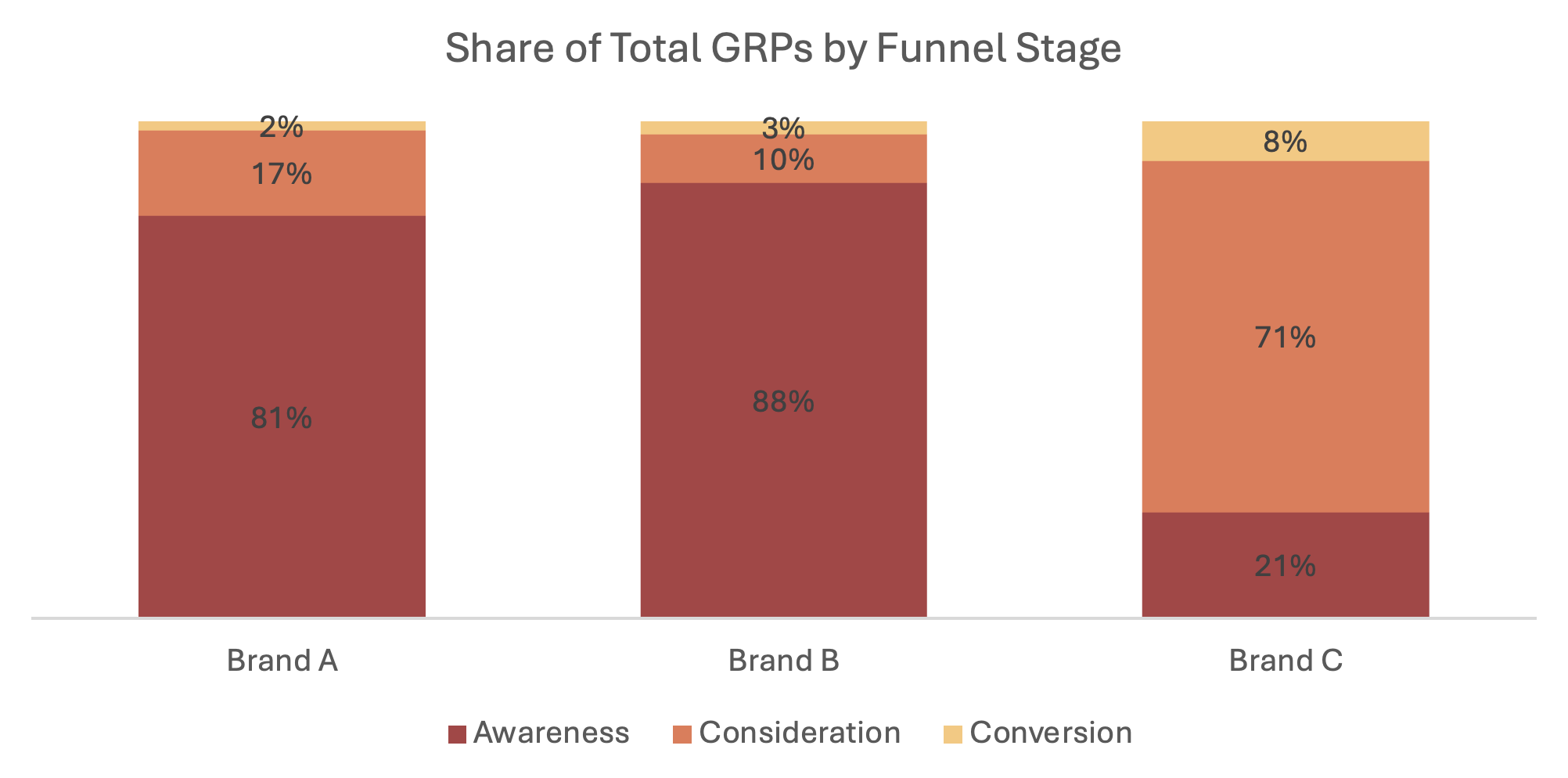
Across different clients, industries, and budget levels, one pattern consistently emerged: the media channels designed to capture existing demand accounted for only a small share of total audience exposure.
On its own, that isn’t particularly surprising. Lower-funnel channels aren’t built to maximize reach—they’re built to efficiently convert consumers who are already demonstrating intent. What surprised us wasn’t the distribution itself. It was how consistent the pattern remained regardless of client, category, or budget. GRPs didn’t tell us which channels were most effective; they helped us understand how each channel contributed to the overall balance of the media mix.
And when we stepped back from individual tactics and looked at the overall media mix, something else became clear. While every channel was doing the job it was designed to do, not every channel was receiving the same level of attention when it came to optimization and investment decisions.
That raised an important question: Are marketers becoming so focused on capturing existing demand that we’re gradually investing less in the channels responsible for creating it?
When Measurement Shapes the Media Mix
This isn’t necessarily the result of poor planning. It’s a byproduct of how modern marketing is measured.
Lower-funnel channels produce immediate, tangible feedback. Marketers can see clicks, conversions, return on ad spend, and cost per acquisition almost in real time. Those signals make it easier to optimize campaigns, justify investment, and demonstrate business impact.
Awareness media plays a different role. Its job is to introduce new audiences to a brand, build familiarity, and influence future consideration. These outcomes often unfold over weeks or months rather than days. While these channels have their own success metrics, they’re rarely as immediate or as directly attributable as lower-funnel performance.
As a result, it’s natural for optimization conversations to gravitate toward the channels that produce the clearest feedback.
Think about how budget conversations typically unfold. Paid Search is exceeding its conversion goal, so more budget is shifted there. Paid social is delivering a lower CPA than expected, so investment increases. Each decision is rational when viewed on its own.
But media plans aren’t shaped by a single decision. They’re shaped by optimization decisions made over time. As those incremental shifts accumulate, a media mix can gradually become more focused on capturing existing demand than creating future demand.
The risk isn’t that performance media becomes too effective. It’s that the channels responsible for reaching new audiences, building familiarity, and influencing future consideration are increasingly asked to compete for budget using the same short-term outcomes as channels designed to capture intent.
Over time, that can reduce a brand’s presence among the audiences it hopes to convert in the future. Demand capture channels may continue to perform efficiently, but their success ultimately depends on there being demand to capture in the first place.
Looking Beyond Performance Metrics
Performance marketing has transformed the way advertisers measure success, and for good reasons. The ability to connect media investment directly to business outcomes has made marketing more accountable than ever before.
But no single metric tells the entire story.
Conversions reveal how effectively a brand captures existing demand. Audience exposure reveals something different: how much opportunity consumers have had to experience that brand before they ever begin searching.
The challenge, of course, is that demand creation is inherently harder to measure. There isn’t a single metric that can tell you exactly how many future customers were influenced by a video campaign, an out-of-home placement, or a streaming audio impression.
That uncertainty doesn’t make those channels less valuable. It simply makes it easier to deprioritize them.
That’s why the goal isn’t to maximize investment in awareness or performance, or to force every channel to prove its value in the same way. It’s to understand the role each channel plays and evaluate it accordingly.
Perhaps that’s the biggest lesson from looking at media plans through a common lens: the channels that are easiest to measure aren’t always the ones that deserve the most attention.
The strongest media plans recognize that measurement should inform investment decisions—not dictate them.
The next time a media plan is optimized, the question shouldn’t only be which channels are producing the most measurable results today. It should also be whether the mix is maintaining enough presence to influence the customers you’ll need tomorrow. Because a media plan built only to capture existing demand may eventually find itself with less demand left to capture.
Frequently Asked Questions
What is the difference between demand creation and demand capture in media?
Demand creation introduces a brand to new audiences, builds familiarity, and influences future consideration. Demand capture focuses on consumers who are already demonstrating intent and helps convert that existing demand into action. A strong media mix typically needs both roles working together.
What are Gross Rating Points (GRPs)?
Gross Rating Points (GRPs) are a media metric used to estimate the total advertising exposure delivered against a target audience. Converting different media tactics into GRPs can provide a common point of comparison for understanding how each contributes to overall audience exposure.
Can GRPs be used to compare digital and traditional media?
Yes, when the necessary audience and impression data are available, GRPs can provide a common lens for comparing audience exposure across digital and traditional media. However, GRPs measure exposure—not effectiveness—and should not replace channel-specific performance metrics.
Why does performance media often receive more marketing budget?
Performance media provides immediate and measurable signals such as conversions, cost per acquisition, and return on ad spend. This makes it easier to demonstrate short-term business impact and justify additional investment, while the effects of awareness media are often less directly attributable.
Why shouldn’t awareness media be measured solely by conversions?
Awareness media is primarily designed to reach audiences, build familiarity, and influence future consideration rather than capture immediate intent. Evaluating it solely on conversions can undervalue the role it plays earlier in the customer journey.
Can focusing too heavily on performance media hurt long-term growth?
It can. Continually shifting investment toward channels that capture existing demand may reduce the resources available to reach new audiences and build future consideration. Over time, that can leave performance channels with less demand to capture.
How should marketers balance awareness and performance media?
There is no universal budget split. The right balance depends on factors such as existing brand awareness, business goals, audience size, market conditions, seasonality, and available budget. Rather than applying a fixed percentage, marketers should define the role each channel plays and evaluate it against the outcomes it is designed to influence.